CMS Proposes Major Cuts to Modifier-25 Billing for 2027
Here's What Providers Need to Know
If your practice regularly bills a same-day E/M visit alongside a procedure using modifier-25, a proposed CMS rule for 2027 could significantly change how much you get paid for it. Here's a plain-language breakdown of what's being proposed, why CMS says it's necessary, and what you can do about it before the comment window closes.
The Short Version
In the CY 2027 Medicare Physician Fee Schedule Proposed Rule, CMS is proposing to cut payment when the same physician (or another physician in the same practice) bills a separately identifiable office/outpatient E/M visit on the same day as a procedure with a 0-, 10-, or 90-day global period.
Under the proposal:
- The single most expensive service billed that day (whether it's the E/M visit or the procedure) would be paid at 100%.
- Every other service billed that day, additional procedures or the E/M visit itself, would be paid at only 50%.
In other words, if you bill aprocedure and append modifier-25 to a same-day E/M visit, only the higher-RVUcode gets full payment. Everything else takes a 50% haircut.
Why CMS Says This Is Needed
Global surgery packages are already built to cover the pre-op, intra-op, and post-op work tied to a procedure, including a certain amount of visit-related work baked into the code's RVU. CMS's concern is that when a modifier-25 E/M visit is billed on top of that same-day procedure, practices may effectively be paid twice for overlapping clinical work. That overlap is exactly what a coding, documentation, and revenue integrity review is designed to catch before CMS does.
This isn't a brand-new idea. CMS floated a similar concept back in the 2019 PFS proposed rule, suggesting a 50% reduction on the least expensive same-day service. It didn't survive to the final rule; commenters pushed back hard, arguing that modifier-25 itself already certifies that the visit is significant and separately identifiable, and that the RUC's coding review process already accounts for overlap. CMS ultimately shelved the idea in 2019 to let the AMA and CPT Editorial Panel work through broader E/M coding changes first.
Now, for 2027, CMS is bringing the concept back, this time expanding it to cover 0-, 10-, and 90-day globals (not just 0-day procedures), and tying the reduction directly to the existing Multiple Procedure Payment Reduction (MPPR) framework already used elsewhere in the fee schedule.
A Worked Example
CMS includes an illustrative example in the proposed rule. Picture a dermatology visit where the patient is seen for an E/M service (CPT 99212) and also has two skin lesions removed the same day (CPT 11300 and CPT 11301). Using 2026 RVU values:
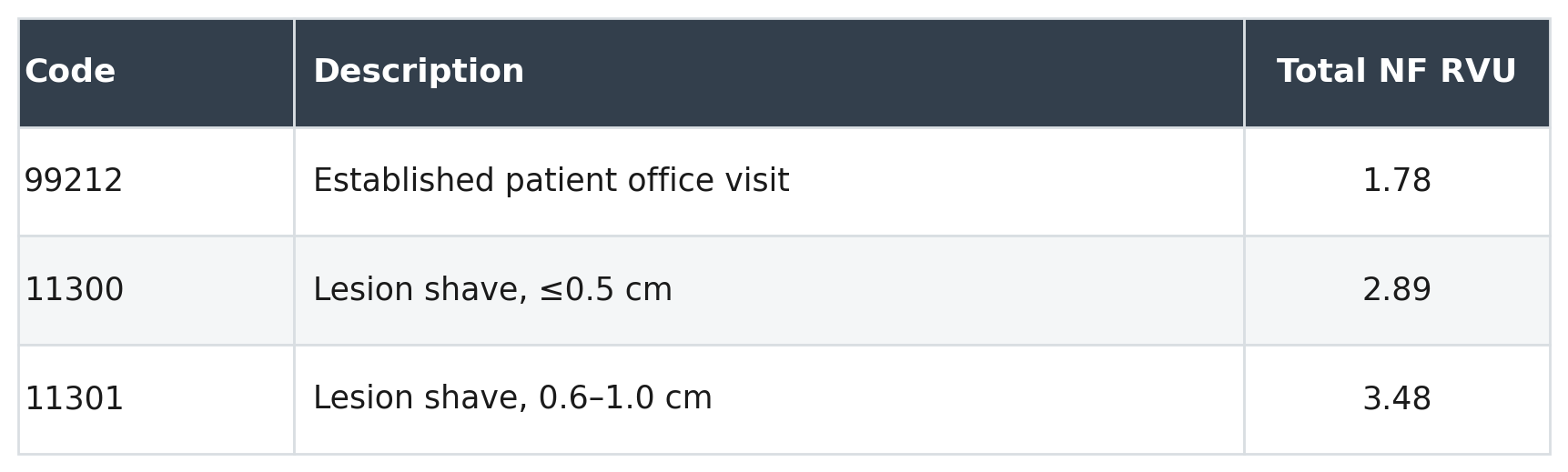
Since 11301 has the highest RVU value, it would be paid at 100%. The other two codes, 11300 and 99212, would each be reduced by 50%, dropping to 1.445 RVUs and 0.89 RVUs respectively. A professional fee coding audit is exactly this kind of scenario, applied to your own claims data.
That's a real revenue hit for practices that regularly perform in-office procedures alongside E/M evaluation on the same day.
What's Still Undecided
A few pieces of this proposal are open questions CMS is specifically asking for feedback on:
- The reduction percentage itself. CMS is proposing 50% to match the existing MPPR standard, but is soliciting comment on whether a smaller cut, such as 25%, would be more appropriate.
- Scope. As written, the proposal only applies to office/outpatient E/M visits. CMS is asking whether it should be expanded to include inpatient E/M visits as well.
- Guardrails against gaming. CMS acknowledges the risk that practices might respond by scheduling procedures and E/M visits on separate days purely to avoid the reduction. The agency says it already has monitoring tools, claims editing, comparative billing reports, and medical review, and is asking whether additional payment safeguards are needed.
Key Dates
- Comment period closes: September 14, 2026
- Final rule expected: Around November 2026
- Effective date, if finalized: January 1, 2027
With the effective date only a year out, this is a good time to have your regulatory compliance program reviewed against what's coming.
What This Means for Your Practice
If a meaningful share of your billing involves modifier-25 claims paired with same-day procedures, it's worth modeling your coding audit exposure against your current billing patterns before this becomes final. A few things to watch:
- This targets same-physician, same-practice overlap specifically. It doesn't appear to change how modifier-25 works when the E/M and the procedure are performed by unrelated providers.
- The rule doesn't eliminate modifier-25 or restrict when it's used clinically. It changes the payment math once it's appended.
- Now is the time to submit comments if this proposal would create a real hardship for your practice or patient population. CMS explicitly asked for feedback on the percentage, the scope, and whether additional guardrails are needed, all of which are still very much in play before the final rule.
You can review the full proposed rule and fact sheet directly on CMS's site, and submit comments through the Federal Register docket before the September 14 deadline.
This post is intended as a general summary of a proposed CMS rule and is not billing, coding, or legal advice. Consult your compliance team or a qualified coding specialist before making changes to your billing practices.
Modeling what this could mean for your reimbursement doesn't have to wait for the final rule.